A Longer-Lasting Light Bulb Is a Worse Light Bulb
In 1925 the world's bulb makers secretly agreed to cap the life of their products at 1,000 hours. The conspiracy was real. The physics behind it was too — and it explains why the bulb that has burned for 120 years is barely worth looking at.
In 1925, the major lightbulb manufacturers of Europe and the United States formed a cartel and agreed to standardise the life of an ordinary household bulb at 1,000 hours. They meant it: members shipped samples to a central laboratory, burned them, and fined each other when the numbers came in too high. At the time, plenty of bulbs on the market lasted considerably longer than that. All of this is documented, and none of it is in dispute.
The conclusion almost everyone draws from it — that the cartel shortened bulb life so you would keep coming back to the shop — is the tidiest available explanation, and it is built on an assumption nobody stops to check: that a bulb which lasts longer is a better bulb. It isn't. Working out why requires going back to the wire.
Everything a bulb does is set by one number
An old-fashioned incandescent bulb is a startlingly simple object. A tungsten wire roughly 20 micrometres thick — a fiftieth of a millimetre — is sealed inside a glass envelope that keeps the air away from it. Run a current through the wire and it heats up until it glows.
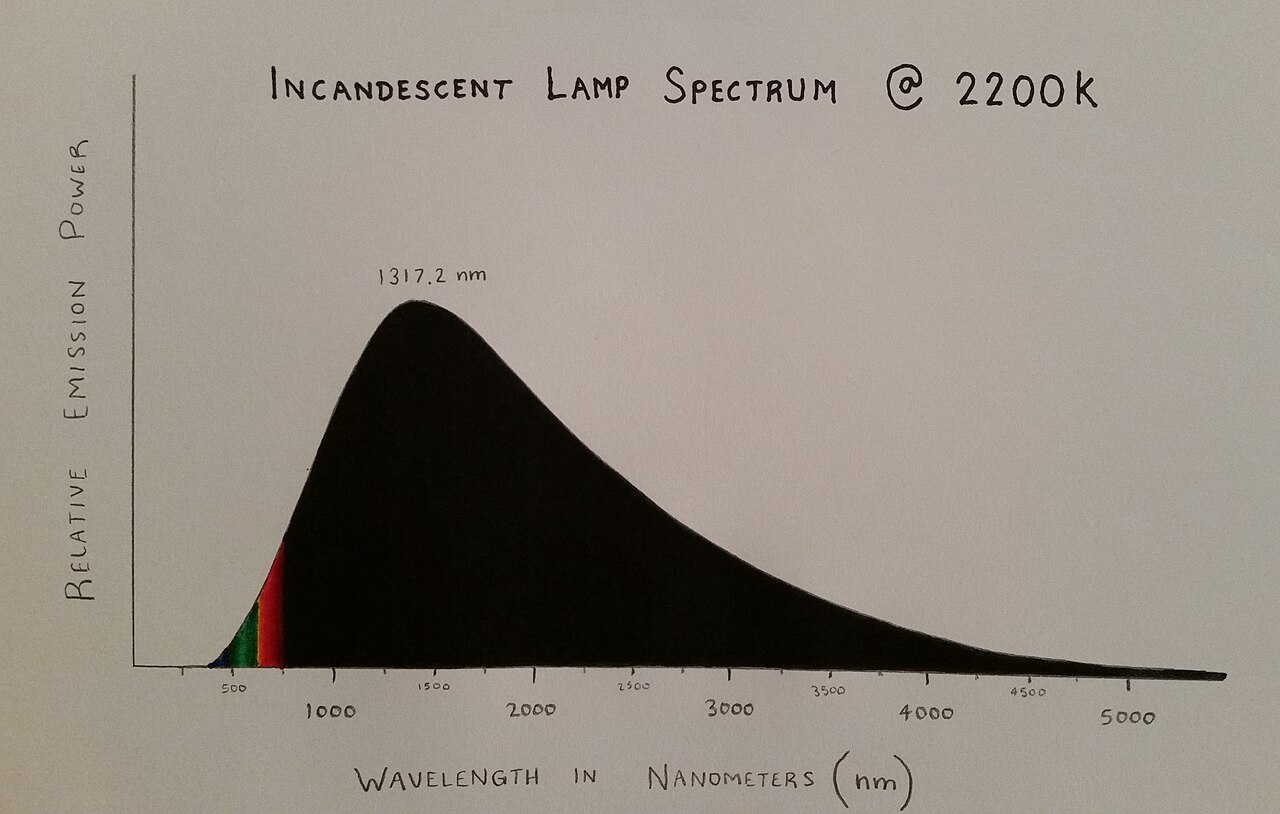
How hot it gets is the only parameter that really matters. It determines the brightness, and it determines the colour. This follows from thermal radiation, the light that every object gives off simply by virtue of having a temperature. Your desk is emitting right now, at wavelengths around 10 micrometres — infrared, which is what a thermal camera is built to see. To shift the peak of that emission into the band our eyes respond to, roughly 400 to 700 nanometres, the wire would have to reach about 5,700 °C, which is the surface temperature of the sun.
Nothing survives that. Tungsten has the highest melting point of any metal and it gives up at 3,422 °C, which is precisely why it is used. Earlier filaments did worse: carbon, made by charring plant fibre, boiled away above about 2,000 °C, and experiments with zirconium dioxide ceramic were capped by a 2,700 °C melting point.
So every filament ever built has run with the bulk of its output in the infrared, and the visible light we actually use is scraped off the high-energy edge of the spectrum. That has a consequence which is easy to miss: because the useful part is a sliver at the far edge, a small rise in temperature makes the lamp dramatically more efficient — not a few per cent better, but orders of magnitude. The same rise pushes the light whiter, because hotter atoms can throw off shorter wavelengths.
The wire is always in the process of falling apart
The catch is what that heat does to the metal. A tungsten filament near its melting point is barely holding itself together. The crystals it is made of slide past one another, so the wire slowly deforms, and individual atoms evaporate off the surface until there is not enough wire left to carry the current. Both processes speed up sharply with temperature.
There is therefore no dial marked "quality" and a separate one marked "lifespan". There is one dial, marked temperature, and turning it one way buys you whiter, brighter, cheaper-to-run light at the cost of a shorter life. Turn it the other way and you buy longevity by giving up everything else. Manufacturers still set that dial to suit the job: photographic floodlights, which need genuinely white light, are built to last a few hours, while indicator lamps buried inside equipment where nobody can reach them are rated for 100,000.
The bulb that has burned for 120 years is barely glowing
The exhibit always produced in support of the conspiracy is a bulb hanging in a California fire station, running more or less continuously since the early 1900s and past a million hours of service. What tends to go unmentioned is what it looks like. Nominally a 60-watt lamp, it draws about four watts, and because a filament that cool is so inefficient, it is dimmer than even four watts would suggest. There is no surviving documentation, but the likeliest explanation is a manufacturing error that left the filament with far too much resistance. It was sold as a night light because it was no good for anything else.
That bulb is not an anomaly so much as an extreme case of an era. Early bulbs were made by hand and were expensive, so they were designed for long life almost without exception. The light they produced was nowhere near white and their efficiency was a small fraction of even a modern incandescent, which is itself a poor performer by any objective measure.
Three dollars in the shop, six dollars on the meter
Automation is what changed the arithmetic. Once bulbs could be turned out by machine, they cost pennies to make and a few dollars to buy, and the balance of costs inverted. At around ten cents per kilowatt-hour, a 60-watt lamp burns roughly six dollars of electricity across a 1,000-hour life. The bulb itself costs about three. Choosing a lamp that lasts longer but consumes more power for the same light means paying more, on the larger of the two bills, for the privilege.
A shopper standing in the aisle cannot see any of this. What they can see is a number on the box. Faced with two 60-watt bulbs, one claiming 400 hours and one claiming 2,000, most people take the 2,000 without deliberating — lifespan is legible, it is a single figure, and it maps directly onto how often you will be back here buying another one. Efficiency is not conceptually difficult, but nobody does homework before buying a lightbulb, and the packaging works against them: it uses input power as a stand-in for brightness, so the idea that two lamps both marked "40 W" might not be equally bright is actively confusing.
That is the trap. Every manufacturer knows the buyer is comparing the one number they can compare, so every manufacturer has to compete on it, and the only way to win is to cool the filament — making the product dimmer, yellower and more expensive to run in ways the customer will not attribute to the choice they made. Competition was not driving the industry toward better bulbs. It was driving all of them, in lockstep, toward worse ones.
Standardising at 1,000 hours stopped that. None of which is a defence of the cartel, which fixed prices, carved up markets and behaved badly in ways that had nothing to do with tungsten; it is hard to believe profit played no part in where exactly the line was drawn. But the line itself has survived its enforcers. The cartel lasted fourteen years. Ordinary incandescent bulbs today last somewhere between 500 and 2,500 hours — a range with 1,000 comfortably inside it.
What the episode really documents is not planned obsolescence but a market failure of a subtler kind, in which each firm behaving rationally produced a collectively worse product because buyers could only judge one axis of a multi-axis object. Whether better labelling and independent testing could have fixed that is genuinely open. It may be that no amount of disclosure makes efficiency as immediate as a number that tells you when you will next be climbing a ladder.
This piece expands on an essay by Maurycy Z on tungsten filaments and the economics of light.
Questions
Did the Phoebus cartel really limit bulb lifespans to 1,000 hours?
Yes. From 1925 the participating manufacturers agreed on a 1,000-hour standard and tested each other's products to enforce it, with penalties for exceeding it. The cartel also fixed prices and divided up markets, which is a separate and genuinely anti-consumer matter.
Why can't a bulb be both long-lasting and bright?
Both properties are governed by a single variable: the filament's operating temperature. Higher temperatures give whiter, more efficient light but accelerate the crystalline deformation and surface evaporation that destroy the wire. Lower temperatures extend life but make the lamp dimmer, yellower and more expensive to run.
What about the bulb in the California fire station that has burned for over a century?
It survives because it is barely working. Rated at 60 watts, it draws roughly four, and its filament runs so cool that it is dimmer than a properly made four-watt lamp. It was most likely a manufacturing defect and was sold as a night light.
Is it cheaper to buy a longer-lasting incandescent bulb?
Usually not. At around ten cents per kilowatt-hour, a 60-watt bulb consumes about six dollars of electricity over 1,000 hours, roughly twice what the bulb costs to buy. A longer-lived bulb that draws more power for the same light loses money on the larger bill.