Copy trading in a trade lab: a smarter way to evaluate strategies
Real copy trading puts capital at risk before you know if the leader's edge is real. Mirror their trades in the lab first, then decide.
7 min read
Real copy trading puts your money at risk before you know whether the leader's edge is real. Past returns are not predictive, leaderboards are gameable, and the trader you are about to copy may have spent six months getting lucky on a single regime.
Trade lab copy trading is a learning loop that fixes this.
The copy-trading evaluation problem
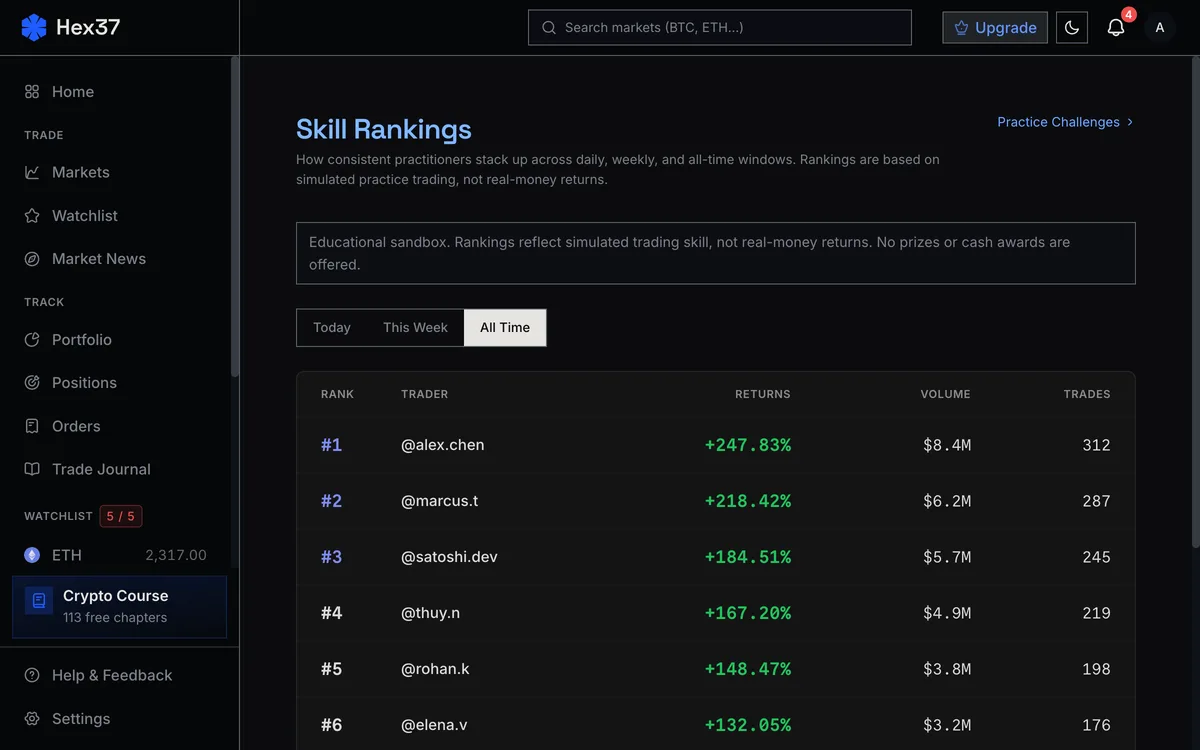
You see a leaderboard. Top trader has +180% over six months. You want in. But: is that 180% from edge or variance? Did they hit one fortunate trade and ride it? Are they about to revert? Real copy trading commits capital to the answer.
The trade lab copy approach
Mirror the leader in the trade lab for 30–90 days. Their trades fill on your virtual balance. Your equity curve evolves alongside theirs. At the end, you have data — not a sales pitch — to decide whether to graduate to real copy.
What to actually measure
- Hit rate. The percentage of trades that close green. Useful but not sufficient — a 30% hit rate with 5R winners beats a 70% hit rate with 0.5R winners.
- Max drawdown. The deepest peak-to-trough loss. Tells you what your worst week of copying looks like.
- Sharpe-ish ratio. Return per unit of volatility. Smooths out lucky months.
- Behavior under volatility. How does the leader behave when the market dumps? Hold? Cut? Add? You learn this only by watching.
- Style consistency. Does the leader trade what they say they trade, or do they revenge-trade alts after a bad day?
How Hex37 does it
Copy relationships are explicit and per-leader. You set an allocation percentage (say, 5% of your virtual balance per leader trade). When the leader fills, your account fills proportionally. Conditional orders (stop-losses, take-profits) and reduce-only orders are excluded from mirroring to avoid cascading liquidations.
An anti-cascade safeguard prevents copy chains: if a trader is themselves copying someone, their fills do not propagate to your account. Cascade depth is hard-capped at one regardless of network topology.
A worked example
You spot a top-10 leaderboard trader with a 4-month track record. You set up lab-copy at 10% allocation. Over 60 days you accumulate ~80 mirrored trades. Their hit rate is 42%, average winner +1.8R, average loser -1R. Max drawdown 12%. You watch them hold through a 15% market dump and add modestly — their thesis is consistent.
Now you have data. You decide whether to graduate to real copy with the same allocation, scale up, scale down, or skip.
When to skip the graduation
- Hit rate is high but R-multiples are tiny — the edge is fragile.
- Drawdowns coincide with regime changes — the leader does not adapt.
- Leader's stated strategy and observed trades diverge — they improvise.
- The 60-day sample includes only one market direction — wait for the other.
For deeper context
Frequently asked questions
What is trade lab copy trading?
Mirroring another trader's positions in a trade lab instead of with real money. You see what they do, how the trades unfold, and how the equity curve develops — without the risk of real capital.
How long should I lab-copy a leader before going live?
30–90 days minimum. Anything shorter is too small a sample to distinguish edge from luck. Look at hit rate, max drawdown, behavior under volatility, and whether the leader sticks to their stated strategy.
Can the leader cheat the leaderboard?
Leaderboard rankings on Hex37 are computed from real audited trade activity. Leaders cannot fake fills. Lab-copying further protects you because you are evaluating their decision quality, not just their result.