Macy's Ads Come Down, Revealing a Century-Old Spite Building
For more than a hundred years, the world's most famous department store hid a five-story neighbour it never managed to buy. The billboards are being stripped off, and the building is briefly visible again.
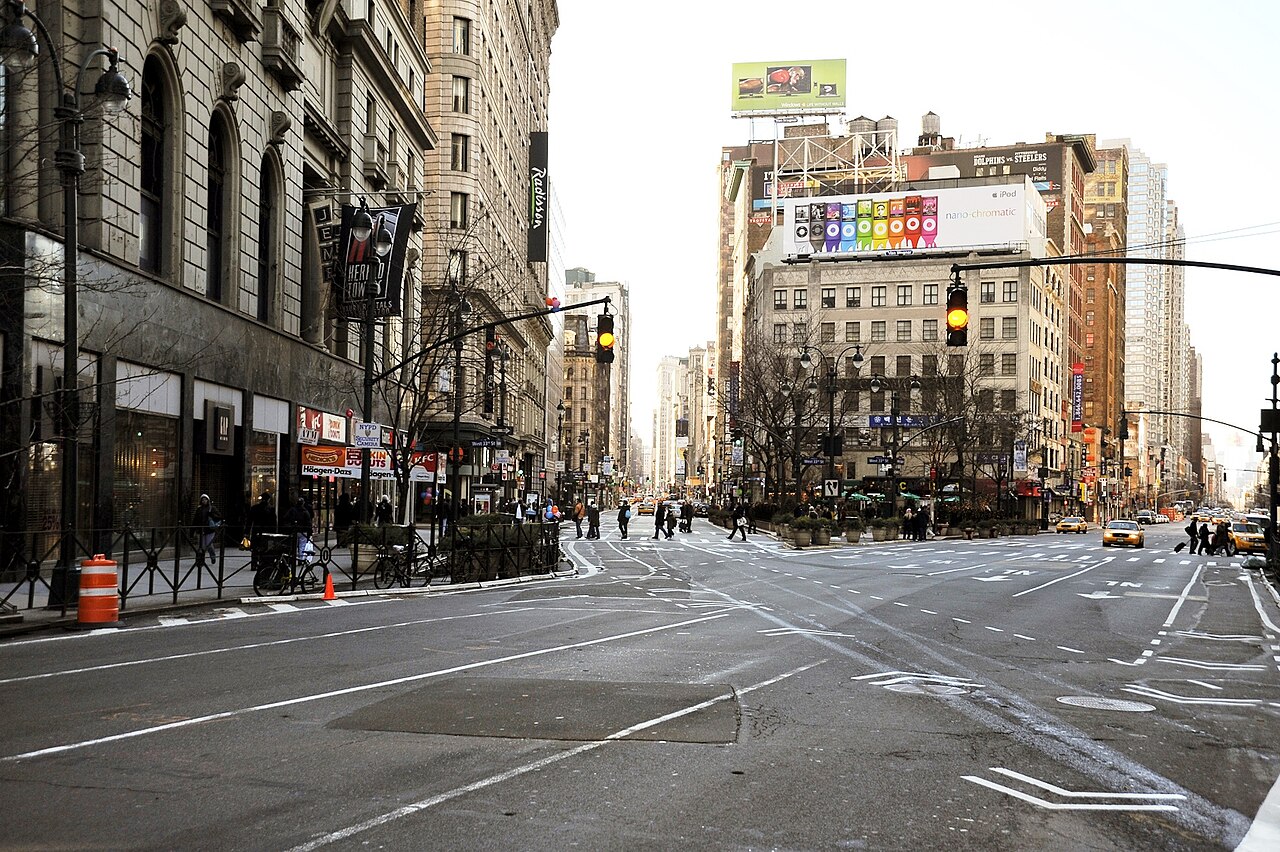
Anyone walking past the corner of 34th Street and Sixth Avenue in Manhattan this summer has been able to see something New Yorkers have not seen in living memory: a building. Specifically, a narrow five-story structure of brick and limestone with oversized studio windows and decorative terracotta trim, wedged into the corner of the Macy's flagship store like a tooth that refused to be pulled.
For decades the facade was a giant painted shopping bag, red and white, advertising the store that surrounds it on two sides. Now scaffolding covers the shopfront, dark netting hangs over the upper floors, and only a patch of red still faces Sixth Avenue. As Ephemeral New York reported, the advertising is coming off for the first time since the early 1900s. The building underneath is grimy, handsome and, in its way, a monument to a commercial grudge that has outlived everyone involved.
The corner Macy's could not buy
The story starts around 1901. Macy's was then a large but conventional dry-goods retailer on 14th Street, in the stretch of Manhattan known as the Ladies' Mile — a corridor of grand emporiums that functioned as the city's shopping district at the end of the 19th century. The company decided to move north to Herald Square, a busier intersection with better transport links, and to build something enormous there.
Assembling the land meant buying out whatever already stood on the block: a restaurant, a barber shop, and Koster & Bial's, a rowdy music hall where the first commercially projected films in the United States were shown in 1896. Macy's got all of it, with one exception. A parcel of about 30 by 50 feet on the corner — roughly the footprint of a modest flat, left over from an old farm — belonged to a clergyman named Duane Pell.
Pell understood exactly what he had. According to a 1922 history of the store by Edward Hungerford, he wanted $250,000 for the plot, a figure the author called astonishing for such a scrap of ground; in today's money it would run into the millions. Macy's, judging that a flagship store needs to own its own corner, agreed to pay.
A rival buys the corner out from under them
Before the deal closed, Pell sold to someone else for $375,000. The buyer, acting through an agent, was Henry Siegel, owner of Siegel-Cooper — "The Big Store" — a competitor on Sixth Avenue at 18th Street with 120 departments and 3,000 staff. That figure, well over ten million dollars in current terms, bought Siegel a piece of leverage rather than a piece of real estate.
He then offered Macy's a swap: the corner, in exchange for one of the 14th Street buildings Macy's was about to vacate. It was a shrewd play. Macy's was leaving the old district anyway, and Siegel wanted a foothold there.
Macy's refused, flatly, and built its new store around the hole instead. The result is the arrangement still visible today — a full city block of department store with a bite taken out of one corner. When the flagship opened in 1902 and Siegel's gambit had plainly failed, he demolished the old structure on the plot and in 1903 put up the five-story building that stands there now, designed by the architect William Hume. Siegel lost control of it within a few years. The corner has been in other hands ever since; the current owner, Kaufman Realty, has held it for more than 60 years.
Renting a wall for a hundred years
What turned an act of spite into a durable business was advertising. From the 1920s onward, Macy's leased the facade of the building it could not buy and covered it with its own signage — an elegant solution to an awkward problem. The store paid rent to a landlord it had once tried to outbid, and in return the corner effectively disappeared. Generations of shoppers assumed the ads were simply part of Macy's.
That arrangement came under strain in 2021, when Macy's went to court after learning that the owner was in talks to lease the facade to an online retailer, widely assumed at the time to be Amazon. Macy's sought an injunction, arguing that a 1963 agreement barred the space from being leased to a competitor and pointing out that a rival's logo would be broadcast to millions during the Macy's Thanksgiving Day Parade, which passes directly beneath it. The dispute captures something exact about what the corner is worth: not the land, which is tiny, but the sightline. A blank wall facing one of the most photographed intersections in the world is an advertising asset, and whoever controls it controls what a competitor's customers see.
Look now
Holdouts like this one are scattered across Manhattan — small buildings whose owners declined to sell, leaving developers to build around them. Most are curiosities. This one is unusually legible, because you can still read the argument in the shape of the block.
The terracotta detailing and tall studio windows now emerging from behind the netting date the building precisely to the moment of the fight: 1903, a period when even a hastily built five-story infill got ornamental clay facing as a matter of course. It has been sitting there, structurally intact and commercially useful, hidden in plain sight for the better part of a century.
How long the view lasts is unclear. The point of stripping the facade was reportedly to prepare it for a new tenant's signage, and no one has said publicly when or whether that will appear. For now, a corner of Herald Square that has been an advertisement since before the Second World War is temporarily just a building again.
Questions
What is a holdout building?
A property whose owner refused to sell to a developer assembling a larger site, forcing the new building to be constructed around it. Manhattan has several; the Herald Square corner is the best known because Macy's flagship store wraps around it on two sides.
Why did Macy's put its own adverts on a building it doesn't own?
Because it could not buy the corner, Macy's leased the facade instead. From the 1920s the store paid the building's owners for the right to cover it in Macy's signage, most recently a giant red-and-white shopping bag, which made the holdout look like part of the store.
Is the building being demolished?
There is no indication of that. The scaffolding and netting are associated with removing the old advertising from the facade, reportedly to prepare the space for a new advertiser. No demolition has been announced.
How much did the corner cost in 1901?
The owner, Duane Pell, asked Macy's for $250,000 and then sold the plot to a rival retailer's agent for $375,000 — a sum equivalent to well over ten million dollars today, for a lot measuring roughly 30 by 50 feet.