How to practise Bitcoin futures in the trade lab (the right way)
Practice BTC futures with leverage, funding, and liquidations, without risking real money. A walkthrough on how to do it right.
8 min read
Practising Bitcoin futures in a trade lab sounds simple. Open an app, click buy, watch the PnL. Most platforms make it that simple, and that is the problem. They omit the parts of futures that matter most: leverage, margin, slippage, funding, liquidation. The lessons you learn on a toy sim do not transfer when you go live.
This is a walkthrough of how to actually practise BTC futures in the trade lab, on a platform that simulates the parts that hurt.
What most simulators usually leave out
Most trade lab platforms fill instantly at mid-price, ignore slippage, simplify margin, never charge funding, and never simulate a liquidation. A trader who learns there will get crushed on day one of live trading because the costs that drive real outcomes were invisible during practice.
What a realistic futures trade lab needs
- Leverage with a real margin requirement.
- Slippage on every fill, not idealized mid-price execution.
- Funding rate debited or credited on schedule.
- Liquidation at a realistic maintenance margin threshold, with a forced-close + adverse slippage receipt.
- Partial fills on large or thinly priced orders.
Walk-through: opening a 5x BTC long
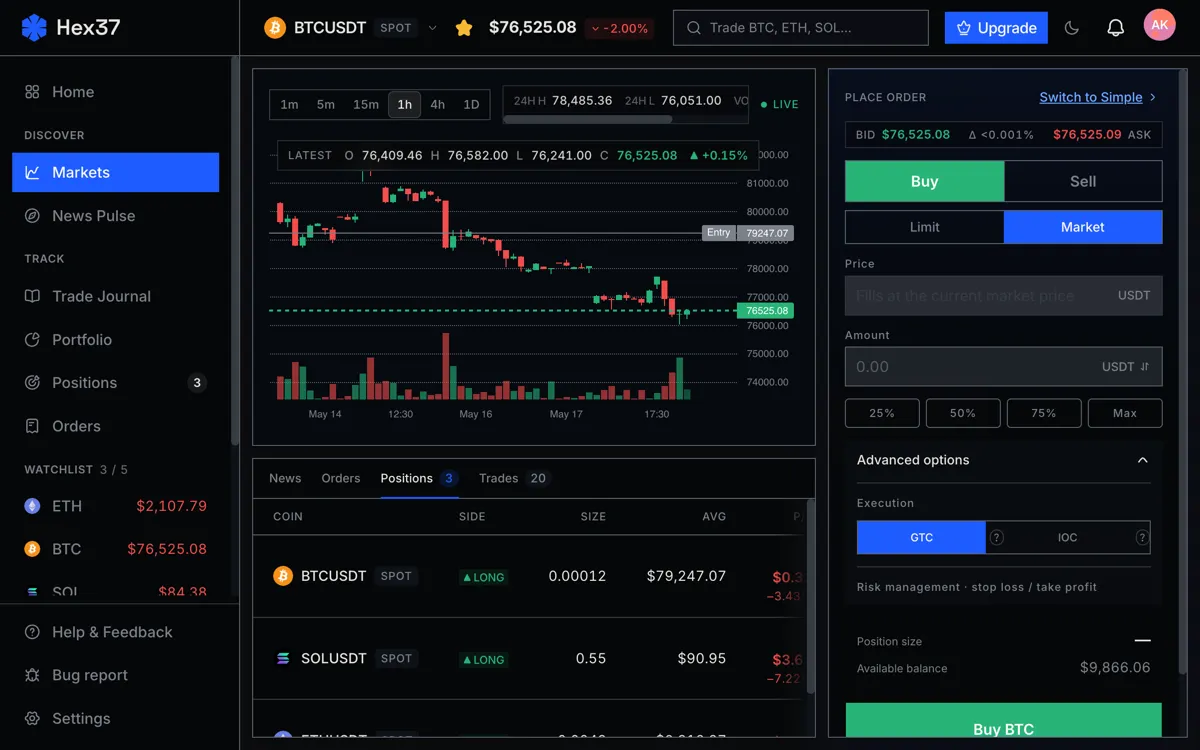
On Hex37: go to /app/markets/BTCUSDT. The chart loads with live Binance prices. In the order form, pick Buy, Limit, set leverage to 5x. Enter your entry price. Use the position sizer: enter your stop price and risk percent (1% is the right default). The form back-calculates the contract size for you.
Toggle bracket order on. Set your take-profit and stop-loss prices. Click Place order. The bracket waits dormant; on first fill of the entry, the stop and target activate as an OCO pair.
Holding through a funding window
BTC perpetuals settle funding every 8 hours (00:00, 08:00, 16:00 UTC). If you hold a long when funding is positive, you pay shorts. If funding is negative, shorts pay you. Hex37 runs the actual Binance funding rate against your position size and adjusts your balance. Open a position, hold it overnight, look at your balance. The funding line item is now part of your education.
What the receipt looks like
After every fill, you see the actual filled price, slippage from your intended price, fee breakdown, and remaining margin. After a liquidation, you see the trigger price, the forced-close price (with adverse slippage modeled), the liquidation fee, and the resulting PnL. No black box. The receipt is the lesson.
What to look for in the journal afterward
The journal logs every trade automatically with R-multiples (the dollar PnL normalized to your planned risk). After 30 trades, look at the breakdowns: average R, win rate, distribution of losers (clustered at -1R or leaking past?), patterns by hour and day. The data tells you whether you have a discipline problem before your real-money equity curve does.
Ready to put this into practice? Open the Bitcoin paper-trade workspace and place your first practice order. No card required.
Where to go next
Frequently asked questions
Can I practise Bitcoin futures for free?
Yes. Hex37 gives every account a $10,000 virtual balance and lets you trade BTC perpetual futures with up to 20x leverage on live Binance prices. No card required.
Does the trade lab simulate funding rates on futures?
On most platforms, no. Hex37 does. Funding is debited or credited every 8 hours based on real Binance funding rates. If you hold a long through a positive-funding window, your balance ticks down by the actual funding amount.
Will I get liquidated on a simulated futures trade?
Yes. The liquidation engine triggers at 1% maintenance margin, just like a real exchange. The forced close, adverse slippage, and liquidation receipt are all simulated. Getting liquidated in the trade lab is the cheapest way to learn what real liquidation feels like.
How much leverage should a beginner use?
Start at 2x to 5x. The math at 20x is unforgiving. A 5% adverse move liquidates you. Work up to higher leverage only after your journal shows discipline at lower leverage.