Why slippage matters more than you think
Slippage is the silent drag that turns a +1R backtest into a -0.2R live result. Here is how it works, where it comes from, and how to account for it.
7 min read
Slippage is the price you got versus the price you asked for. On a single trade it sounds trivial — a few cents on a Bitcoin order. Over hundreds of trades it is the difference between a profitable strategy and a losing one.
What slippage actually is
When you click Buy at $66,000 and the order fills at $66,033, the $33 is slippage. It comes from three sources:
- Bid-ask spread. The cheapest sell price is always slightly above the most expensive buy price. A market buy crosses the spread and pays the higher price.
- Market impact. A large order eats through multiple price levels of the book. Each level is more expensive than the last.
- Latency. In the milliseconds between you clicking and the exchange matching, prices move. Usually away from you.
The hidden cost
Quick napkin math: 0.1% slippage per round-trip × 100 trades a month = 10% drag annually. If your edge is 15% before costs, slippage just ate two-thirds of it. Many strategies that look profitable in backtest are net losers after realistic slippage.
Why simulators that omit slippage break beginners
A trader who runs a trade lab with zero slippage learns to size aggressively and accept tight stops. On the live exchange those same tight stops fire constantly because real execution does not give the ideal price. The lesson never transferred — the sim taught the wrong intuition.
How Hex37 simulates slippage
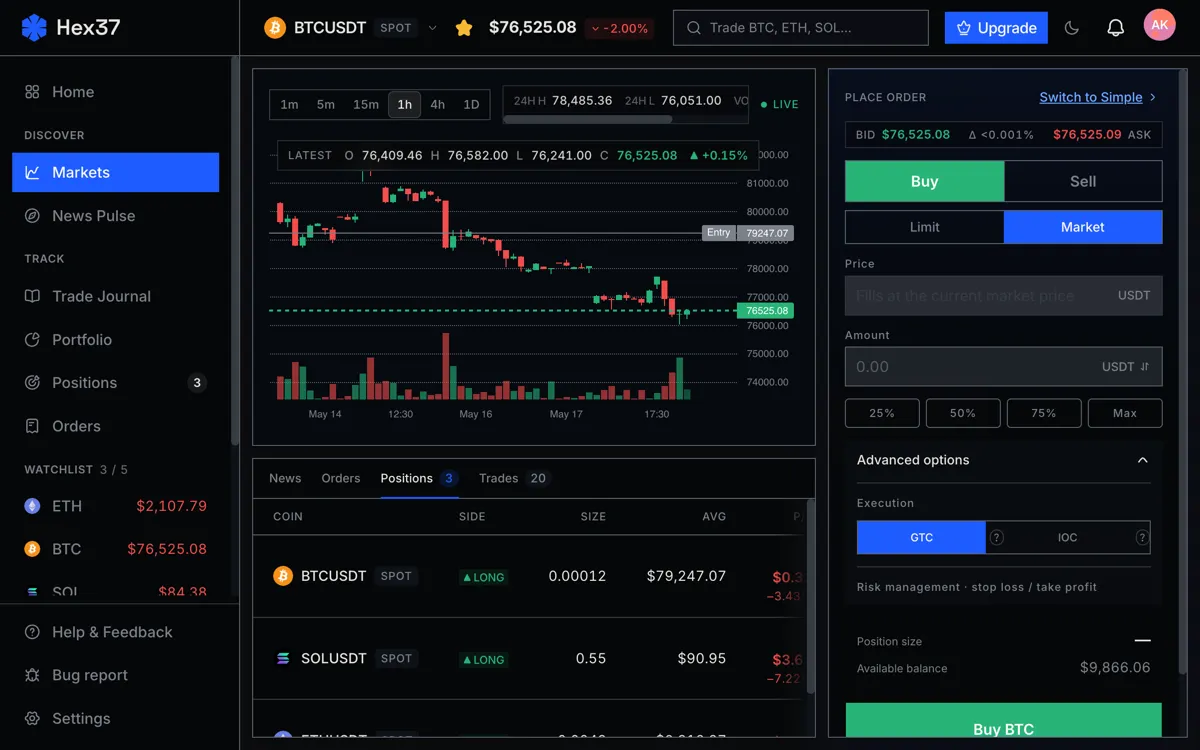
Every fill on Hex37 carries 0.05–0.2% randomized slippage, calibrated to typical Binance liquidity for the instrument. The number scales with order size relative to recent depth. The fill receipt shows you exactly what slippage you paid on every trade, so it becomes visible instead of magical.
How to account for slippage in your strategy
- Assume worse than backtest. If you backtested at zero slippage, add 0.1% per round-trip to your cost model.
- Prefer limit over market when timing permits. A patient maker fill avoids the spread and the market-impact cost.
- Size down on thin pairs. Slippage on low-volume altcoins can dwarf your edge.
- Avoid trading the open and the news. Spreads widen, slippage explodes.
For deeper context
Frequently asked questions
What is slippage?
Slippage is the difference between the price you intended to fill at and the price you actually got. On a market order it almost always works against you.
How big is slippage typically?
On liquid pairs (BTC, ETH) in normal conditions, 0.02% to 0.1% per fill. On thinly-traded altcoins or in fast moves, 0.5% to 2%+ is realistic.
How do I reduce slippage?
Use limit orders when timing permits, size down on thinly-traded pairs, avoid trading during low-liquidity hours, and assume worse-than-backtest slippage in any strategy estimate.