TradingView's built-in simulator: what it gets right and where it falls short
TradingView is the best chart on the internet, but its built-in simulator omits slippage, partial fills, funding, and liquidations. Here is when to use it — and when you need something else.
6 min read
TradingView is the best charting tool on the internet. The drawing tools, the indicator library, and the network effect of public ideas are unmatched. Its built-in simulator is convenient, sits one click from your chart, and is free with any TradingView account. So why look elsewhere?
What TradingView's built-in simulator is good for
Practicing setups visually. If your goal is "can I see this pattern in real time and click the right button", TradingView Paper is fine. The fill happens, your PnL updates, you move on. For idea-generation and chart-pattern training, it works.
The realism gap
- Instant mid-price fills. No slippage modeling. Your order fills at the price you clicked, every time. Real markets do not behave this way.
- No partial fills. Real orders frequently fill in chunks. TradingView paper fills are atomic.
- Simplified margin. Leverage and margin are abstracted; you do not see the same liquidation pressure a real exchange would apply.
- No funding rate. If you hold a perp through funding windows, nothing happens. In real life, your balance moves.
- No liquidation engine. A position that would have been forcibly closed in reality just keeps running on paper.
Where this breaks
For leveraged trades, futures, or any strategy whose profitability depends on fill quality (scalping, market-making, arbitrage), TradingView's built-in simulator produces wildly optimistic results. You cannot tell from the equity curve whether your strategy works because the simulator is hiding the costs that determine the answer.
What Hex37 does differently
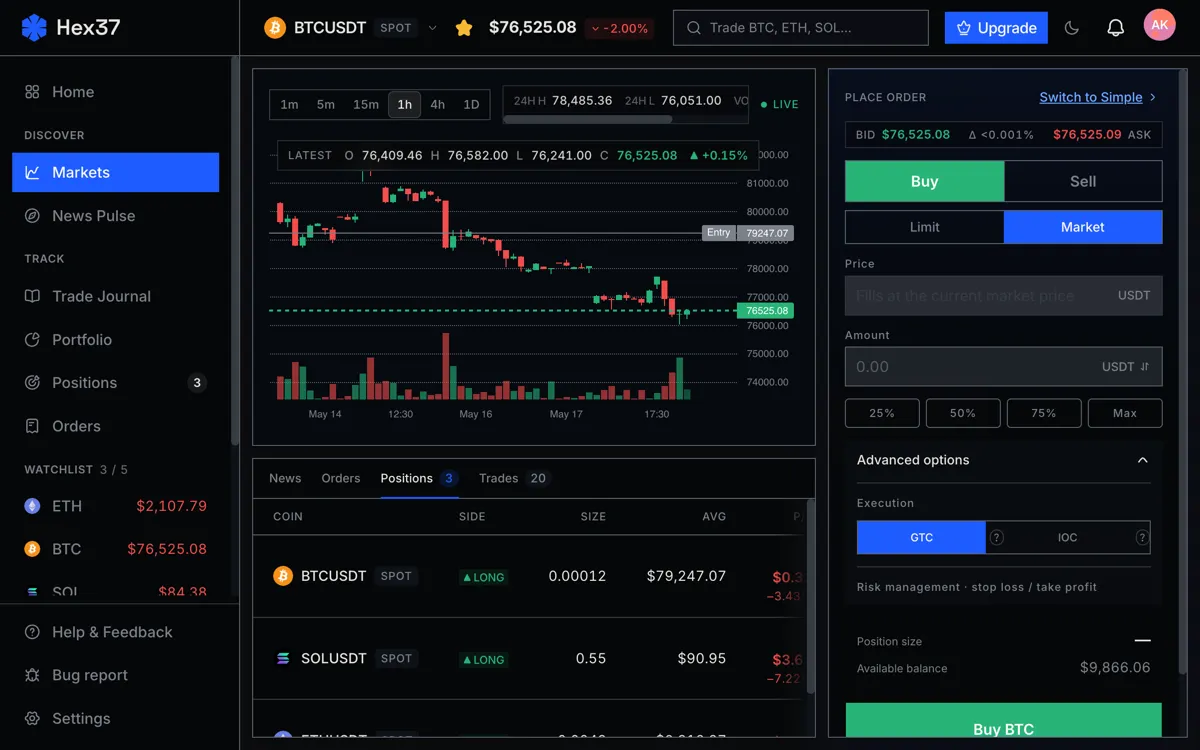
Hex37 is built specifically for execution realism. Tick-based matching engine. Probabilistic fills. 0.05–0.2% randomized slippage calibrated to liquidity. Real Binance funding rates debited every 8 hours. 1% maintenance margin liquidation engine with forced-close and adverse slippage modeled. The receipt for every fill shows you exactly what happened.
When to use which
TradingView for charting, indicator development, and public ideas.
Hex37 for execution practice, futures, and anything where fill quality matters.
They are complements, not competitors. Most serious traders end up using both.
For deeper context
Frequently asked questions
Is TradingView's built-in simulator realistic?
For chart practice, yes. For execution practice, no — it fills instantly at mid price, does not model slippage, and does not simulate funding or liquidations.
Can I practise futures on TradingView?
Through a connected broker, yes. The fill realism depends on the broker. Most simulator integrations use idealized fills.
What is a better alternative for execution practice?
Hex37 is built specifically for execution realism — tick-based matching, slippage, partial fills, funding, and liquidations. Use it alongside TradingView, not instead of.