How to practice futures trading without losing money
A 30-day practice plan for futures trading. Internalize leverage, margin, funding, and liquidation distance before risking real capital.
9 min read
Practicing futures matters more than practicing spot. Leverage means mistakes hit harder and faster. A 5% adverse move at 10x leverage is a 50% drawdown, and at 20x it is a liquidation. The math does not care about your reasoning.
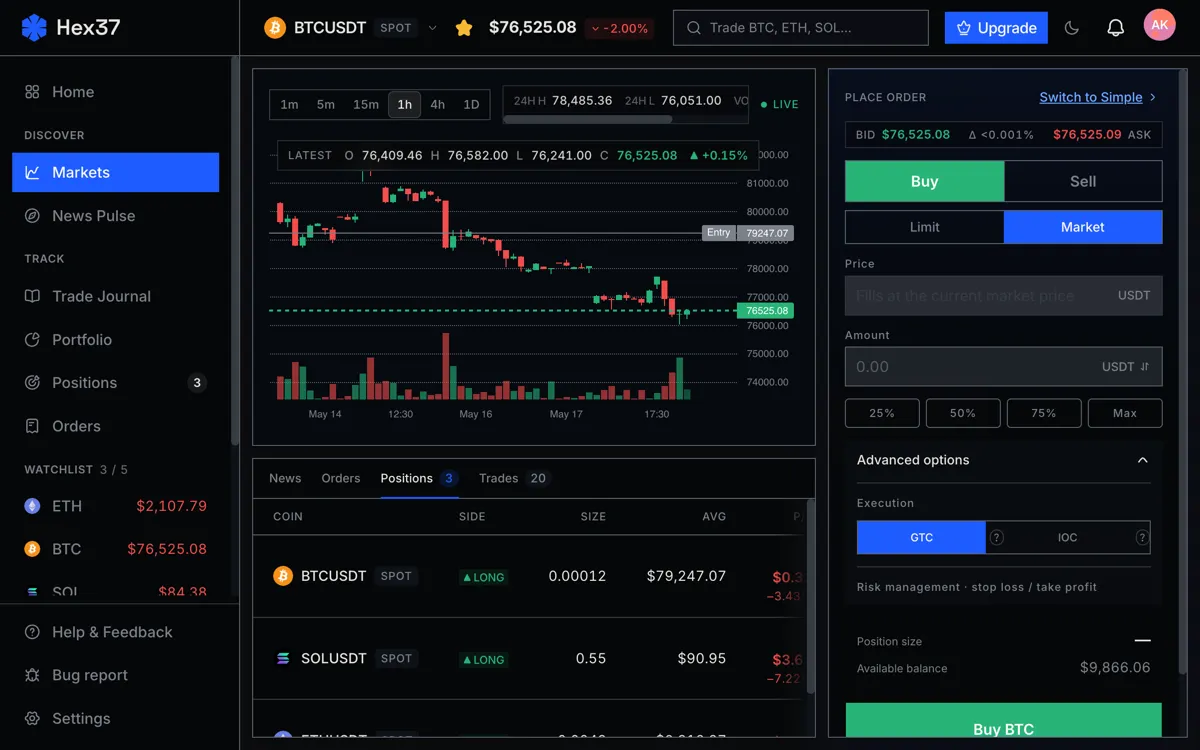
Four mechanics every futures trader needs to internalize
- Leverage math. 10x means a 1% move equals 10% of your margin. 20x means 0.5% equals 10%.
- Margin. Initial margin opens the position. Maintenance margin must be preserved or you get liquidated.
- Funding. Perpetual contracts charge or pay funding every 8 hours. Holding a long through positive funding costs you. The cumulative effect compounds.
- Liquidation distance. Where the price has to move for the exchange to close you out. At higher leverage, this distance shrinks. At 50x, it is around 2%.
A 30-day practice plan
Week 1: Understand fills
Place 20 small trades. Watch the fill receipts. Notice slippage, partial fills, the difference between market and limit fills. Goal: stop being surprised by execution.
Week 2: Add leverage
Stay at 2x–5x. Use the position sizer for every trade. Watch how the implied leverage changes as you adjust risk percent and stop distance. Goal: build intuition for the math.
Week 3: Hold through funding
Take at least three trades that you hold across an 8-hour funding settlement. Watch the funding line item appear in your balance. Goal: feel funding cost as a real number, not an abstraction.
Week 4: Stop-loss discipline
Every trade gets a bracket order. No exceptions. Review the journal at the end of the week: how many of your stops fired vs your targets? What was your average R-multiple per loser? Goal: prove to yourself that discipline produces a survivable equity curve.
Tools you need
- A simulator with realistic execution.
- A journal that logs trades automatically with R-multiples.
- A position-sizing calculator integrated into the order form.
Hex37 bundles all three. Free tier covers everything in this plan.
Common beginner mistakes (and how to instrument against them)
- Cranking leverage to "feel something". The journal will surface this — your improvised high-leverage trades will have systematically worse R-multiples. Set a hard rule: max leverage equals double the position-sizer suggestion.
- Skipping the bracket toggle. Every unbracketed trade is a trade where your worst case is "I forgot". Make bracket on the default.
- Holding losers in hopes of recovery. The journal flags positions held past their stop. Look at the data after 50 trades — your held losers are statistically your worst trades.
- Trading every signal. Quality over quantity. The journal's per-day trade count vs PnL chart tells you whether you trade too much.
For deeper context
Frequently asked questions
Why practice futures specifically?
Leverage punishes mistakes 10x faster than spot. A spot trader can survive a 50% drawdown; a 10x futures trader gets liquidated at -10%. The mechanics are different enough to require dedicated practice.
How long should I practice before going live?
Plan for at least 30–60 days and 100+ trades. The goal is not time — it is enough trades for your journal to surface real patterns and for your discipline to be tested under varying conditions.
Should I start with high leverage?
Start at 2x–5x. Higher leverage compresses the time-to-mistake; the lessons land faster but the cost of internalizing them on real capital is brutal. Use practice to learn discipline at low leverage first.